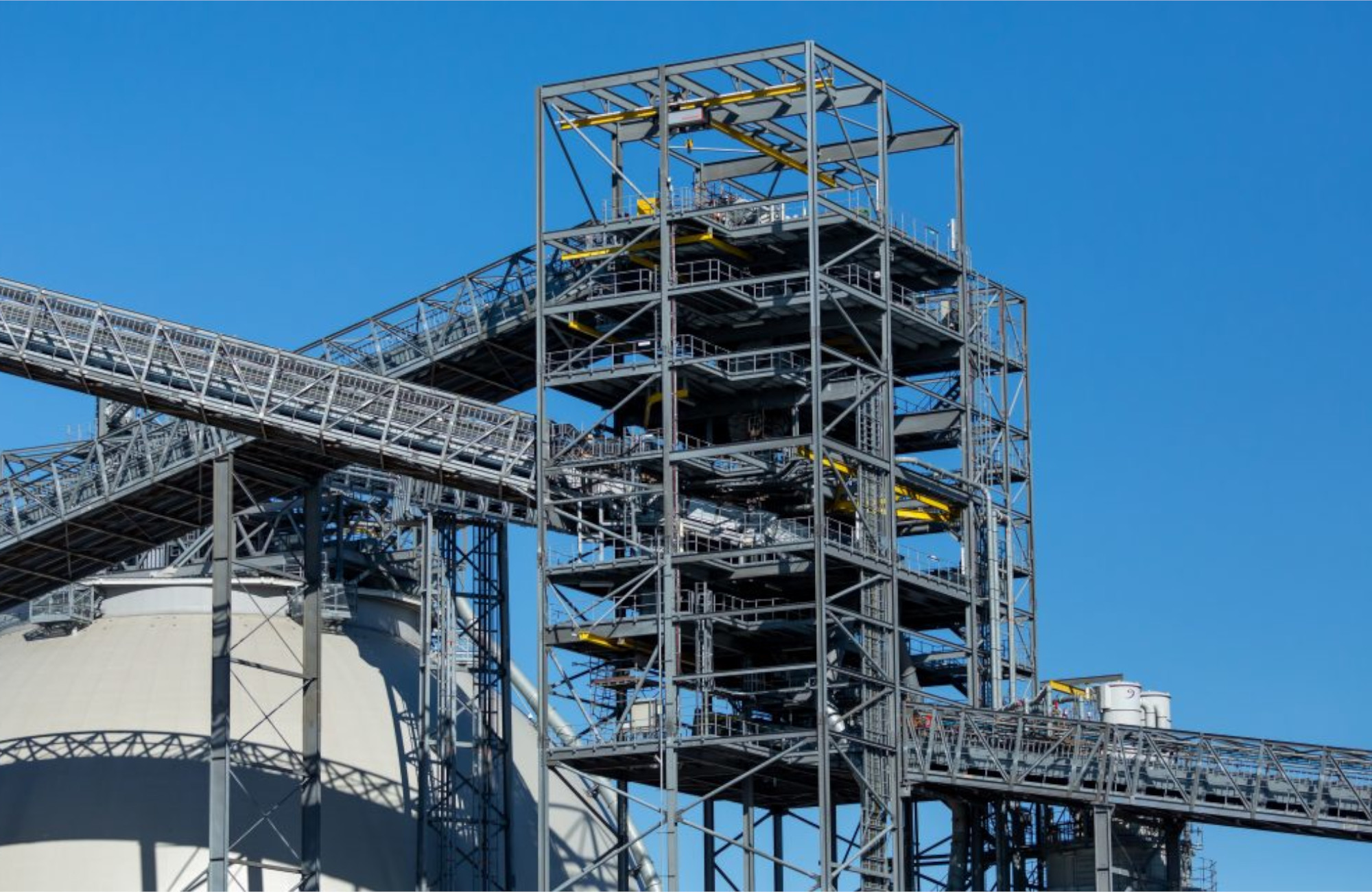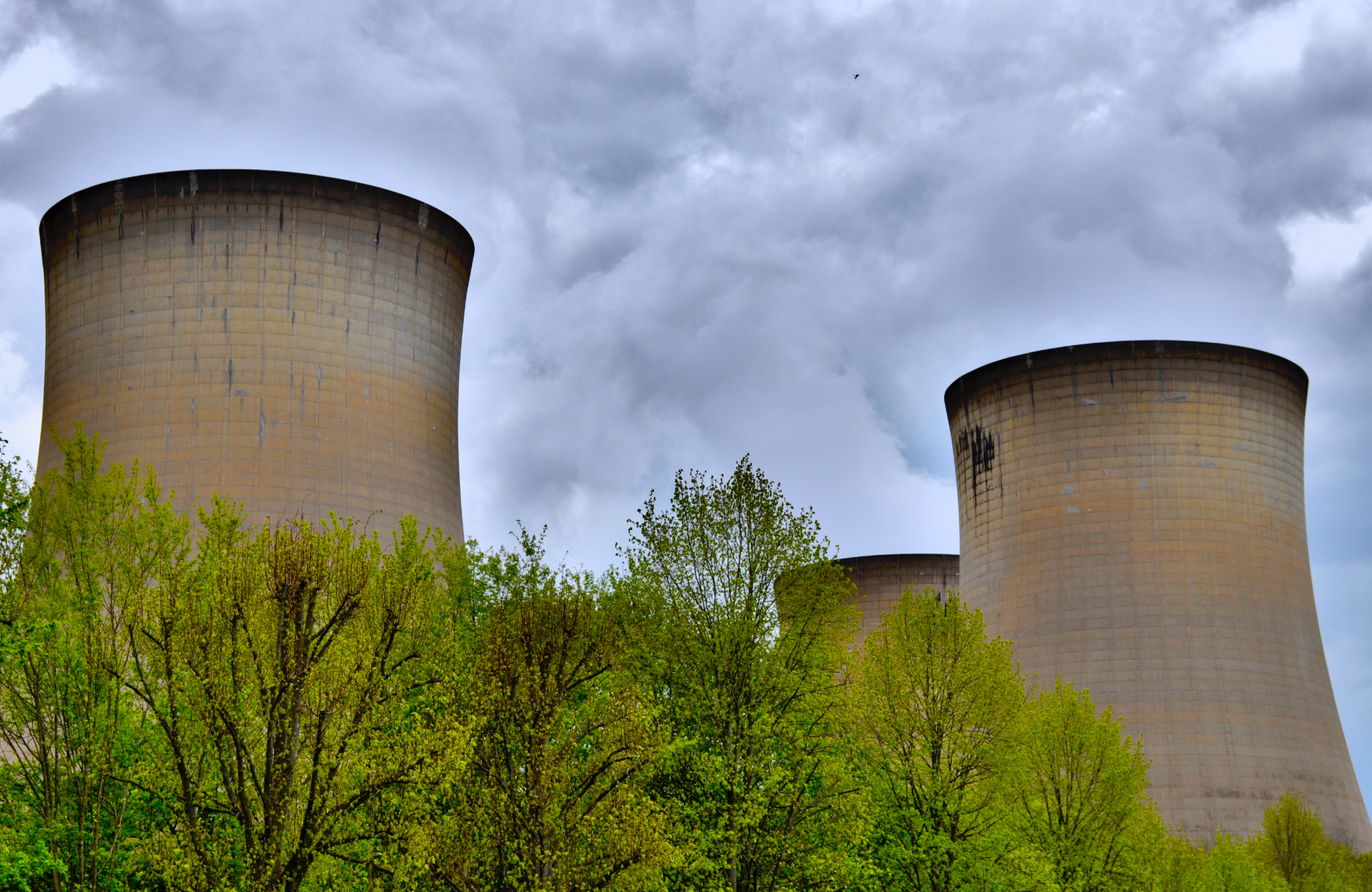
Face east at dawn in the Yorkshire village of Camblesforth, and you might find the morning light blocked by a dozen 100 metre-tall cooling towers. Drax is the UK’s superlative power plant – its largest, most polluting, and most politicised – and its scandals have cast a long and recurrent shadow over the nation’s energy policy in recent years.
Drax’s business is inherently controversial: since 2012, the company has received billions of pounds in green subsidies from UK billpayers to burn wood. Woodburning is legally classified as renewable because trees grow back, and its greenhouse gas emissions are not officially acknowledged, as they are supposed to be recorded by the forestry sector when the wood is logged. Conveniently for the UK, Drax’s fuel is sourced abroad, providing the country with nominally net-zero power.
Beyond broad questions of greenwashing, the company’s own operations have done little to calm its critics. Amongst the numerous exposés that have shifted public and political opinions on Drax, Land and Climate Review uncovered thousands of environmental violations at its North American wood pellet mills, and documented allegations of serious health impacts from its air pollution in the US and the UK.
We often receive questions about these issues, and about Drax’s future. Following news that Drax has topped the UK’s list of largest emitters for another year, with record CO2 levels, we thought it a good time to recap the full Drax story.
Sustainability suspicions
Early plans for Drax to source biomass domestically quickly proved unviable, so it relies on foreign imports. Numerous investigations have alleged that this includes wood logged from environmentally precious forests. In Estonia and in Portugal, for example, campaign groups linked Drax’s suppliers to logging in Natura 2000 sites, which are designated as protected areas by the European Union.
Responding to a Channel 4 News investigation into Drax’s Estonian sourcing in 2021 (above), Drax stated that forests were not protected at the time they were cut down, and that they were “managed in such a way that there’s no damage to biodiversity.”
It is Drax’s Canadian operations, however, that caught the world’s attention. A large proportion of the wood burned at Drax Power Station since 2012 has been Canadian, and in 2021 Drax bought two thirds of the wood pellet mills in British Columbia.
The following year, a BBC Panorama documentary accused the company of owning logging licences used to cut down centuries-old trees. On film, presenter Joe Crowley followed trucks delivering the wood to Drax mills, and questioned the company’s narrative that it relies on waste and residues.
Drax’s initial response to the BBC and the UK government was to deny the allegations and suggest it was considering legal action. Evidence later emerged that Drax executives jumped the gun here, expressing false confidence before conducting internal research.
Later investigations – first by senior staff, then by multiple external firms – were unable to disprove the BBC’s findings. This was not initially made public, and only emerged later through leaks and whistleblowing by staff to journalists, MPs, and even litigation, in the case of Drax’s former Head of Public Affairs, Rowaa Ahmar.
People are often surprised to learn that the BBC’s findings did not prove a breach of UK sustainability rules that would disqualify Drax for subsidy. At that time, the energy regulator (Ofgem) only required 70% of Drax’s fuel supply to meet sustainability criteria, and there was technically no ban on sourcing from old-growth, primary forest. Drax’s next subsidy contract, which becomes active in 2027, will now reform both of these issues.
BBC Panorama did create regulatory issues for Drax, however: firstly, that it had misreported its fuel types in its official data submissions to Ofgem, and secondly, that it may have misled government ministers and shareholders when it refused to accept the BBC’s findings.
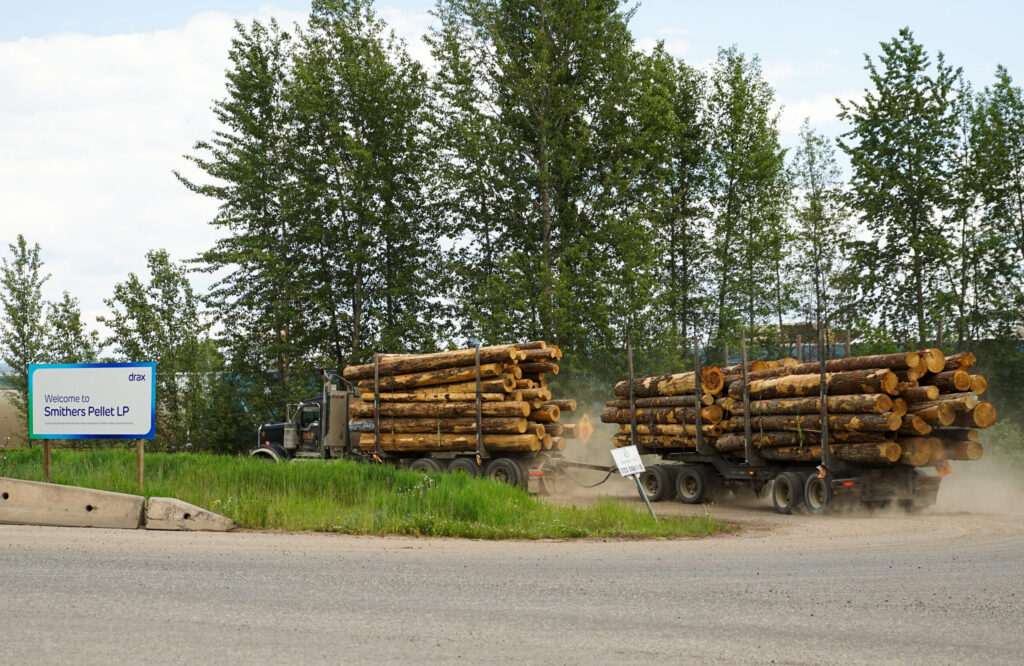
Above: Whole logs are delivered to Drax’s pellet mill in Smithers, British Columbia on Wetʼsuwetʼen territory in June 2024. ©️Desiree Wallace / Stand.Earth
In 2025, an Ofgem investigation concluded that Drax had likely misreported data in 2022. The regulator reached a £25 million settlement with the company, and commissioned another audit of its supply chain, the first part of which concluded in April.
It apparently found no issues, but Ofgem has made the inexplicable decision not to publish it, despite stating the purpose of the audit was to “ensure transparency” and “provide the public with assurance”. Last month, the UK’s Financial Conduct Authority similarly closed its investigation into Drax’s communications to shareholders, without outlining details.
Joe Crowley followed his initial BBC investigation with others that demonstrated Drax had also misreported its wood in 2021, and had continued sourcing from primary forests in 2023. In 2023, Drax committed to stop sourcing from designated old-growth areas in British Columbia, but at the time of writing its website still states that “work to implement this…is ongoing.”
A 2025 investigation by Stand.Earth found that Drax purchased whole logs cut from old growth forests in 2024, and very likely in 2025. Responding to the report, Drax said that “Drax does not source biomass from designated areas of old growth,” and that it typically used wood rejected by commercial sawmills, which would have been burned regardless.
Drax has now announced that Canadian wood will no longer feature in its UK supply chain at all by 2027, when the new subsidy regime’s ban on primary forest wood enters into force. Drax Group continues to run the Canadian pellet mills, however, which will instead supply markets in Japan and South Korea.
Something in the air
Drax’s US operations are the focus of a separate scandal. State authorities have issued Drax with numerous multi-million dollar fines for air pollution offences at its US wood pellet mills: our investigations documented over 18,000 breaches of environmental regulations at these facilities, as well as hundreds across British Columbia and Alberta.
Drax is the UK's largest recipient of green subsidies for biomass. They've been under particular focus as this year the BBC reported it had burned wood from rare forests in Canada. Now, #Newsnight's @katelamble has seen evidence of almost 200 environmental breaches at the mills… pic.twitter.com/nmq1UAQDEf
— BBC Newsnight (@BBCNewsnight) May 15, 2024
Above: watch a segment from BBC Newsnight’s coverage of our investigation into environmental violations at Drax’s Canadian facilities.
Drax has repeatedly released hazardous and carcinogenic chemicals at unpermitted volumes. Residents living near a Drax facility in the Mississippi town of Gloster have campaigned for years to restrict Drax’s pollution to safer levels. Many community members believe Drax bears responsibility for health crises in the town, though Drax denies this.
- Bioenergy, Politics & law
UK biomass plant awarded £1 billion green subsidy despite 600 pollution incidents
- Bioenergy, Politics & law
Drax-owned facilities broke environmental rules more than 11,000 times in the US
- Bioenergy, Politics & law
Drax fined again over pollution: “I’m afraid to go outside,” say residents
Drax’s own UK workers have also had disabling health problems, and these have been diagnostically linked by medical specialists to the finely ground dust in wood pellets. Last year, Land and Climate Review revealed at least 10 lawsuits have been filed against the company by current and former employees, who suffered from skin conditions and respiratory illness.
Trailblazing fantasies
Drax’s Canadian logging and pollution is scrutinised more in Westminster than in Ottawa or Washington D.C., because Drax Group’s international businesses would not be profitable without UK subsidies. Despite occasional talk of Drax developing other biomass power plants abroad, the company’s future remains dependent on UK government contracts.
While the logging and pollution scandals were playing out, Drax was negotiating a renewal of its existing subsidy from 2027, as well as new subsidies to add carbon capture technology to the power plant. If Drax is already carbon neutral, the logic goes, then filtering and storing any of its smokestack emissions would make it carbon negative.
Drax’s subsidies are already costly – they reached £999 million last year – and unpopular with voters and MPs alike, especially after a 2023 Bloomberg investigation revealed Drax ‘gamed’ the system to inflate costs to billpayers by hundreds of millions during a cost-of-living crisis. (At the time, the company defended its practices, telling Bloomberg it had acted responsibly to avoid the risk of biomass shortages posed by Russia’s invasion of Ukraine.)
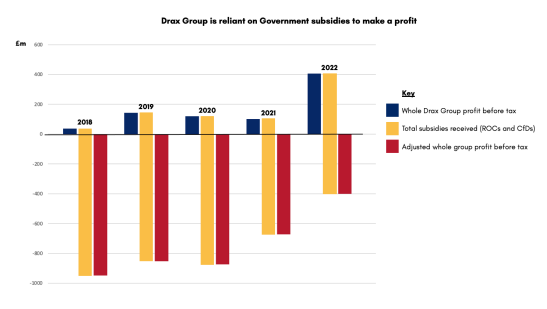
Above: a chart from Heatland & Co’s 2023 report on Drax’s finances.
Against this backdrop, Conservative governments under prime ministers Boris Johnson, Liz Truss and Rishi Sunak became increasingly nervous to promise Drax the tens of billions needed in additional subsidies to develop bioenergy with carbon capture and storage (BECCS).
Tory backbenchers routinely joined with other parties in criticising Drax in parliamentary debates and committees between 2022 and 2025. Even senior energy secretaries including Kwasi Kwarteng, Jacob Rees-Mogg and Clare Coutinho privately objected to Drax’s subsidies, despite continuing to support biomass and BECCS in official statements.
This is not to say Drax had no friends in government. Ed Davey, Clare O’Neill, Graham Stuart and Lord Callanan all used ministerial positions in the energy department to push positive narratives for Drax.
In December 2022, Lord Callanan went so far as telling the House of Lords that “Government officials engaged extensively with forestry experts and Canadian officials, and we are confident that wood pellet production in the region is sustainable…they are not virgin trees.” Embarrassingly for him, we now know he made this statement two hours before Drax met with government officials to brief them on their own audits, which had by then confirmed the opposite was likely true. The government has never explained this incongruence or identified the “Canadian experts”.
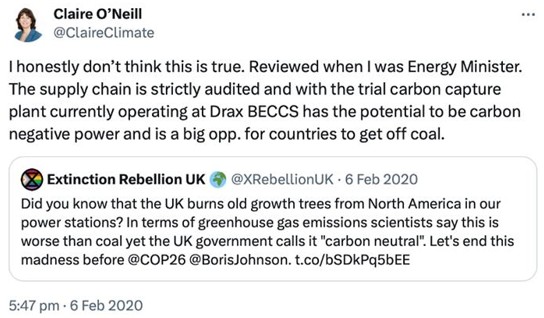
Above: a screenshot of a tweet by Claire O’Neill in February 2020, in which she claims to have reviewed Drax’s sourcing when she was Energy Minister, and concluded that Drax did not burn wood from old-growth forests. In later years, authorities eventually accepted the opposite to be true.
Drax had also developed close and friendly dialogue with government officials – or as the company’s former external affairs director Jonathan Oates admitted to a courtroom in 2025, “there is a bit of a revolving door, if you like, between the business and the civil service.”
By the time Labour won the 2024 general election, however, Drax had fallen out of political favour. Excited to be attacking the government’s biomass policy instead of defending it, Conservative politicians rushed to defend their legacies. Writing in The Times, the departing energy secretary Clare Coutinho tried to position herself as having been a solitary insurgent within government, fighting against “enormous insistence from officials” to subsidise BECCS at Drax.
“I started pulling at threads and the case for Beccs simply unravelled,” she wrote, saying she “always got” the same response from civil servants: “But, Minister, we have to do it”! Unsympathetic to their pleas, she “refused” and “banned” them from further entreaties.
Overdramatisation aside, the broader narrative here is likely accurate: civil servants pushed BECCS, Tory ministers were nervous about it, but lacked the political will or ability to decide against it, and so they kept kicking the can down the road.
Even after Drax was excluded from a shortlist of companies to receive carbon capture funding in 2023, much to the surprise of Drax itself, ministers backtracked and claimed Drax would have its own, separate funding process later on.
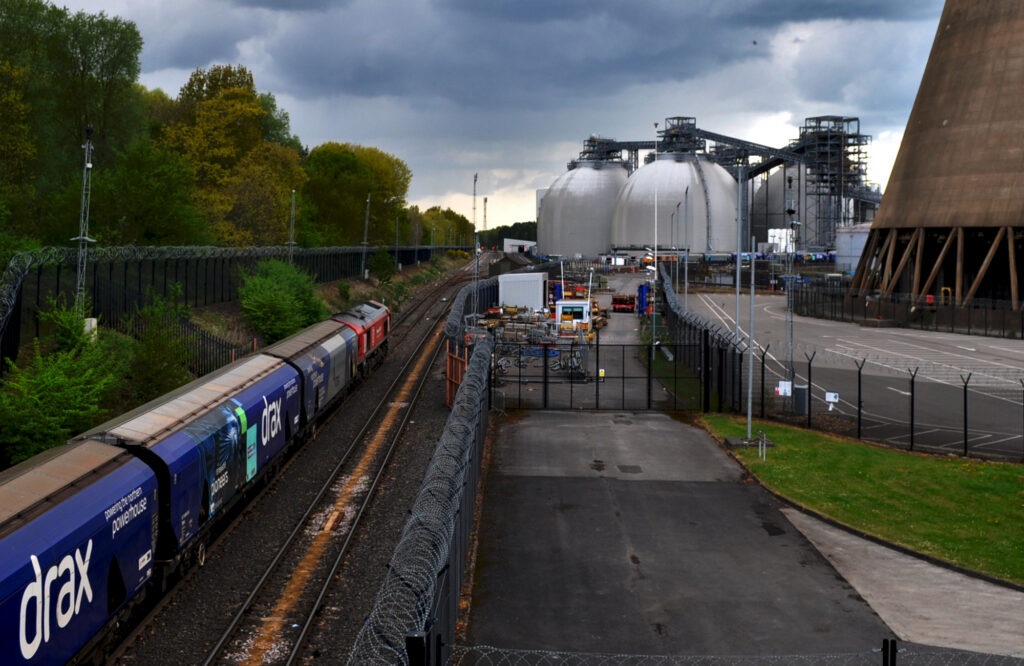
Above: wood pellets are delivered by train to fuel Drax Power Station. ©️Bertie Harrison-Broninski, 2025
In 2025, Labour broke the inertia, and renewed Drax’s contract from 2027-2031. There are some caveats: as well as slightly tightened sustainability criteria, Drax’s generation levels have been lowered.
More significant is the shift in tone: where the Conservatives framed this subsidy as a “transition mechanism” to BECCS, Labour’s announcement stated it would not be realistic for BECCS to “form the primary basis of this decision”. Minister Michael Shanks acknowledged “concerns about sustainability and the level of subsidy” received in the past, and stated that biomass “is not a long-term solution.”
BECCS was acknowledged as having a “potential role” in a distant future, but there have been few indications of Drax progressing towards it since. The company is currently restructuring, and hundreds of staff are likely to have been made redundant by 2027.
Drax’s warm relationship with civil servants also appears to have chilled. Staff used to have regular monthly meetings with top officials working on carbon capture policy, but has not met with any senior energy department officials since 2024. Drax has indicated that development of carbon capture is paused until it receives governmental guarantees about funding.
There are reasons to be sceptical that it ever will. Rumours are rampant that governmental plans for carbon capture are being scaled down amidst rising cost estimates and competing defence budgets. It is worth remembering that Drax has been here before: hundreds of millions in public funds were spent on developing a carbon capture project near the power station in the early 2010s, only to be cancelled due to cost concerns in 2015.
This is the overwhelming trend with carbon capture projects in general: hundreds of announced developments around the world have been cancelled due to high costs or poor delivery, while only a small handful have any claim to success (and even those are contentious).
For many years, Drax’s Plan B if BECCS in Yorkshire failed was BECCS in the USA. That dream has now collapsed as well, after the Trump administration gutted subsidies for climate tech. Plan C is apparently to follow the herd into the overinflated AI bubble just before it bursts, continuing the company’s remarkable commitment to investing its future in high-risk technological zeitgeists.
Unlike the heyday of its lobbying for BECCS, Drax has not announced any memorandums of understanding with companies keen to collaborate on a biomass-powered hyperscale datacentre, and it has only just begun the planning process for a small-scale test-case facility.
Five years is a long time for UK politics and for the tech sector, and Drax may be hoping another government will look on biomass more favourably. That would be a mistake: Labour has bought it time to shift investment to cleaner energy sources. Ending its reliance on coal proved it can make such transitions. Rather than hiding in the shadows until 2031, Drax should let a new day dawn.