Table of Contents
The cryosphere — the Earth’s frozen parts, including snow, sea ice, ice sheets, glaciers, and permafrost — is entering a state of rapid and profound disruption. Ice sheets and glaciers are losing mass, Arctic and Antarctic sea ice is retreating, and permafrost is thawing.
These changes are already triggering cascading risks: threatening coastal settlements with rising seas, destabilising food and freshwater systems in glacier-fed regions, and amplifying extreme weather as polar warming reshapes global atmospheric and ocean circulation.
Over the past decade, scientists have observed multiple parts of the cryosphere approaching thresholds beyond which change becomes irreversible. We are now at risk of a self-sustaining feedback loop, where warming interacts with cryospheric loss, triggering a climate tipping point. Evidence demonstrates that critical cryospheric tipping points may be crossed at or even before a 1.5 °C increase in global warming. These are not distant theoretical risks. We are observing them now.
What irreversible ice loss looks like
If greenhouse gas emissions continue on a high trajectory (around 3°C warming by 2100), the West Antarctic Ice Sheet could cross a critical threshold by 2060 due to warm ocean water melting its protective ice shelves from below, leading to accelerated glacial ice discharge.
This event would be irreversible within human lifetimes and would commit future generations to significant, unavoidable sea level rise, potentially locking in over a metre of sea level rise by 2100 and several metres over the course of centuries. Such a rise would devastate coastal communities, infrastructure, and ecosystems globally, forcing large-scale migration and economic disruption. Even partial retreat of the West Antarctic Ice Sheet would have profound impacts on coastal cities, deltas, and small island states, increasing flooding, damaging infrastructure, and driving long-term displacement and economic losses.

Beneath the ground, permafrost thaw is already releasing carbon and other gases long stored in frozen soils, adding a new and poorly accounted-for source of greenhouse gases to the atmosphere. Northern permafrost regions contain roughly twice the amount of carbon currently in the atmosphere. As soils warm, microbes decompose previously frozen organic matter, releasing CO₂ and methane, a gas more than 80 times more potent than CO₂ over 20 years. Even with big cuts, these emissions are expected to continue for centuries, and are not included in current global carbon budgets. This means that the world can afford far less continued greenhouse gas emissions than is often implied by headline numbers.
We are now at the 11th hour, where every year – and every major opportunity for international climate diplomacy – could determine the future of our planet. Actions taken or delayed now will determine cryosphere stability on timescales far beyond political cycles.
A unified scientific warning
Dozens of the world’s leading institutions have recently endorsed an open letter to world leaders, warning that there are already indications that tipping points have been crossed.
Initiated by four major polar research networks, BEPSII, ASPeCt, CATCH, and PACES, the letter states that “the evidence is unequivocal: the cryosphere is destabilising at an alarming pace. Melting ice sheets and glaciers are driving sea-level rise; sea-ice loss and permafrost thaw are altering global climate patterns; and these shifts are already affecting ecosystems, water resources, and human security worldwide.”
The letter continues: “The 1.5°C limit is not a political aspiration but a planetary guardrail that we are now perilously close to breaching. Crossing this threshold risks triggering irreversible tipping points in the cryosphere, locking in catastrophic impacts for centuries to millennia. Already, early signs of such changes are emerging even at lower levels of warming.”
A mismatch between physical and political timeframes
Typically, cryosphere change unfolds over decades to centuries, well short of a human lifetime. Policymakers operate within short electoral or negotiation cycles that prioritise next-term wins, budget constraints, and immediate challenges. As a result, actions with consequences that extend beyond a single political term receive less attention, even when the underlying physical processes have already been initiated.
For the cryosphere, this mismatch is dangerous: once thresholds are crossed, the system continues to accelerate on its own trajectory, regardless of future policy reversals. The challenge is not that these risks are distant – many early warning signs are already visible – but that their most severe impacts will fall on future generations, outside the time horizon of current political incentives. Addressing cryosphere tipping points requires leadership and governance structures that prioritise long-term planetary stability, even as short-term political priorities shift.
Consequences are already visible
Between 1992 and 2020, the Greenland Ice Sheet lost an average of 170 billion tonnes of ice per year, while West Antarctica lost roughly 80 billion tonnes annually. These losses will continue for centuries, committing the world to long-term sea level rise even if warming stabilises.
Every additional centimetre of global sea level matters: it amplifies storm-surge flooding, accelerates saltwater intrusion into freshwater aquifers, and increases the frequency of coastal flooding events. Low-lying island states already face forced relocation planning, and megacities are spending billions on sea walls and adaptation measures.
Mountain glaciers are retreating so rapidly that over 40% of all glacier mass is expected to be gone by 2100. Together with a drastic decrease in meltwater from snow, these changes threaten water supply and infrastructure for billions of people living in or directly downstream of mountain areas.
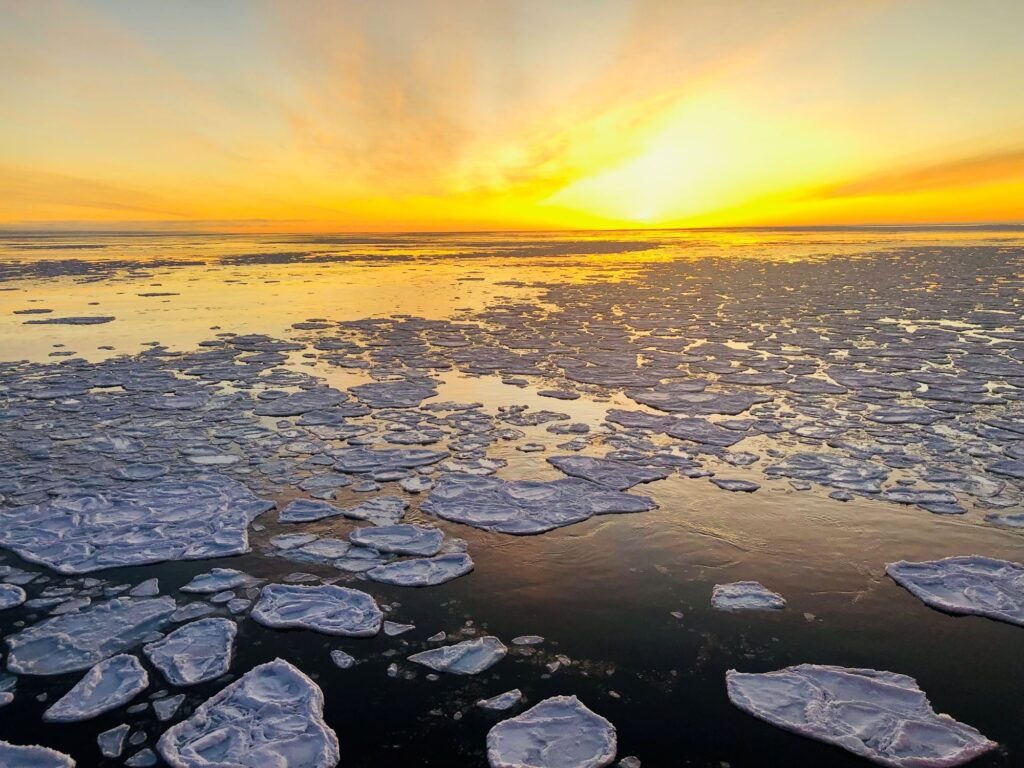
Arctic sea-ice loss is amplifying mid-latitude heatwaves and droughts across the Northern Hemisphere. The 2021 heat dome across western North America, which killed more than 1,400 people, has been partly attributed to circulation changes linked to Arctic warming. Fisheries are shifting northward, undermining food security for Indigenous communities whose livelihoods depend on sea ice ecosystems. Meanwhile, an emerging Arctic shipping corridor is reshaping geopolitics and raising environmental and safety risks that no state is fully prepared to manage.
Antarctic sea ice has declined by over 2 million square kilometres by 2016, compared to the 1979-2022 average – an area the size of Mexico – suggesting a regime shift in the Southern Ocean. And the consequences extend far beyond the Southern Ocean. Shifting storm tracks have intensified droughts and wildfires in parts of South America, South Africa, and Australia. Krill populations have declined in low-ice years, affecting regional fisheries and predator populations. Reduced sea-ice protection also leaves ice shelves more exposed to wave erosion, further intensifying long-term sea-level rise.
Thawing permafrost is damaging infrastructure, such as buildings, roads, and pipelines, with repair costs projected to exceed US $20 billion by mid-century. Entire communities in Alaska are already relocating as the ground beneath them collapses. Thaw slumps also release previously trapped mercury, raising concerns for food safety in subsistence fisheries.
These changes underline that the difference between 1.5°C and 2°C of global warming is not symbolic: it marks the boundary between a system that might still stabilise, and one that will not.
Our recommendations for COP30
Cryospheric change is already impacting finance, migration, and infrastructure decisions far beyond the Earth’s poles. The World Bank estimates that by 2050, more than 216 million people could be displaced by climate impacts, with glacier retreat and shifting water availability among the main drivers in mountain regions of Asia and South America.
Munich Re reports that 2024 was one of the costliest years on record for weather disasters, causing US $320 billion in total losses and US $140 billion in insured losses, far above long-term averages. Weather-related events accounted for 93% of all economic losses and about 11,000 deaths, as global temperatures reached roughly 1.5°C above pre-industrial levels. Such extremes are being intensified by polar amplification and disrupted circulation patterns that connect the fate of the cryosphere with climate risk everywhere.
As this year’s major climate conference, COP30, continues in Belém, these realities expose a widening gap between physical urgency and political pacing. Closing that gap will depend on bringing the cryosphere into the centre of climate governance.
Integrating cryosphere thresholds within the Global Stocktake would link global progress directly to the risks of ice loss, permafrost thaw and sea-level rise. Accounting for these thresholds in Nationally Determined Contributions would ensure emission pathways reflect feedbacks from melting ice and thawing permafrost. Incorporating them into adaptation planning would help to safeguard water and food systems that rely on snow and glacier melt, while aligning climate finance with long-term observation and resilience would focus investment where delays carry the highest cost.
More broadly, we suggest four policy priorities to prevent irreparable planetary harm:
- Deep and immediate emissions reductions across all major sectors, to stabilise warming as close as possible to 1.5°C.
- Scaling up low-risk carbon drawdown, such as restoring peatlands, wetlands, tundra, and coastal ecosystems — not high-risk geoengineering.
- Delivering scaled and transparent climate finance for adaptation and for loss-and-damage in cryosphere-affected regions.
- Sustained investment in cryosphere monitoring and early-warning systems, which are essential global public goods that enable governments to plan.
These should be active negotiating questions for COP30, and their outcomes will shape global climate stability for generations. If these limits are crossed, predictability will erode, undermining the conditions that make societies secure and economies viable.
The open letter can be read in full by clicking here.
Letizia Tedesco is a Senior Research Scientist at the Finnish Environment Institute and an Adjunct Professor at the University of Helsinki, Finland. She co-chairs the BEPSII science network, which initiated the open letter.
Josephine Z. Rapp is the Science Coordinator for the global research and exploration vessel REV Ocean, based in Oslo, Norway. She serves on the steering committee of the BEPSII network.
Petra Heil is Director of Science at the British Antarctic Survey in Cambridge, UK, and an associate with the Australian Antarctic Program Partnership in Hobart, Australia. She also holds leadership roles with the World Meteorological Organisation and the Scientific Committee on Antarctic Research.